Indian summer was already fading, but the weather remained warm and mild — simply perfect for a cycling tour.
Then, out of the blue, a Polish acquaintance called me. He was driving from Lviv to Poland the following day. So what did that have to do with me? Lviv was almost six hundred kilometres from Kyiv. But a crazy idea immediately flashed through my mind: he could take my bicycle across the border. No customs checks, no hassle — and I would find myself in exactly the right place. Besides, I had been planning a cycling trip through Poland for a long time.
The madness lay elsewhere: I had to make a decision right there and then. The train from Kyiv to Lviv was leaving in an hour. I made up my mind instantly. How could I let such good weather and such an opportunity slip away? I quickly packed my things, jumped on my bike and headed for the station.
And so began one of the most dangerous and idiotic journeys of my life. The one I somehow managed to survive.
I raced over Kyiv's hills, narrowly avoiding cars at almost every turn, and arrived at the station at breakneck speed. I had bought my ticket in advance. There was almost no time left.
I bounded up the stairs, raced along the platform — and saw the train already beginning to move.
There was no time to think. No time to be disappointed, either.
I grabbed my bike and leapt aboard the departing carriage.
The conductor saw me and didn't close the doors. I was lucky that Ukrainian trains don't have automatic doors.
Or perhaps I was terribly unlucky? Maybe it would have been far better if those doors had simply closed — and ended the whole story right there.
But everything began wonderfully. The colours, the sounds, the smell of the forest, the atmosphere — everything was steeped in the freshness of autumn. The breeze against my face was pure bliss. The world seemed to breathe slowly and evenly.
I arrived in the Polish town of Przemyśl, where a cycling route of more than 250 kilometres through eastern Poland began. The town descended towards the river along a series of hills, its old houses scattered across the slopes almost at random. Narrow streets dipped downhill and climbed again, while towers rose one after another above the rooftops.
Beyond Przemyśl, the landscape opened into endless fields and a succession of similar little villages. Everything was bathed in brilliant sunshine beneath an impossibly blue sky. A fresh, invigorating breeze followed me along the way. Gradually, the journey began to feel rather monotonous.
Jarosław did little to change that impression. At first glance, it seemed like just another quiet old Polish town. But behind its heavy façades lay inner courtyards and multi-level cellars — an entire second city stretching deep underground. Goods had once been stored there, but now those dark labyrinths seemed like places where something quite different might be kept. They reminded me of ancient Lebanese cities, where the dead were buried beneath the floors of houses — the city of the living literally stood above the city of the dead.
There was an almost otherworldly tranquillity throughout the journey. No planes, no motorways, hardly any cars. It was only towards evening, after covering more than half the distance, that I began approaching Zamość.
The air had become dense and transparent, like glass. The sun no longer gave off much warmth. It merely skimmed low across the ground, stretching long, pitch-black shadows behind everything.
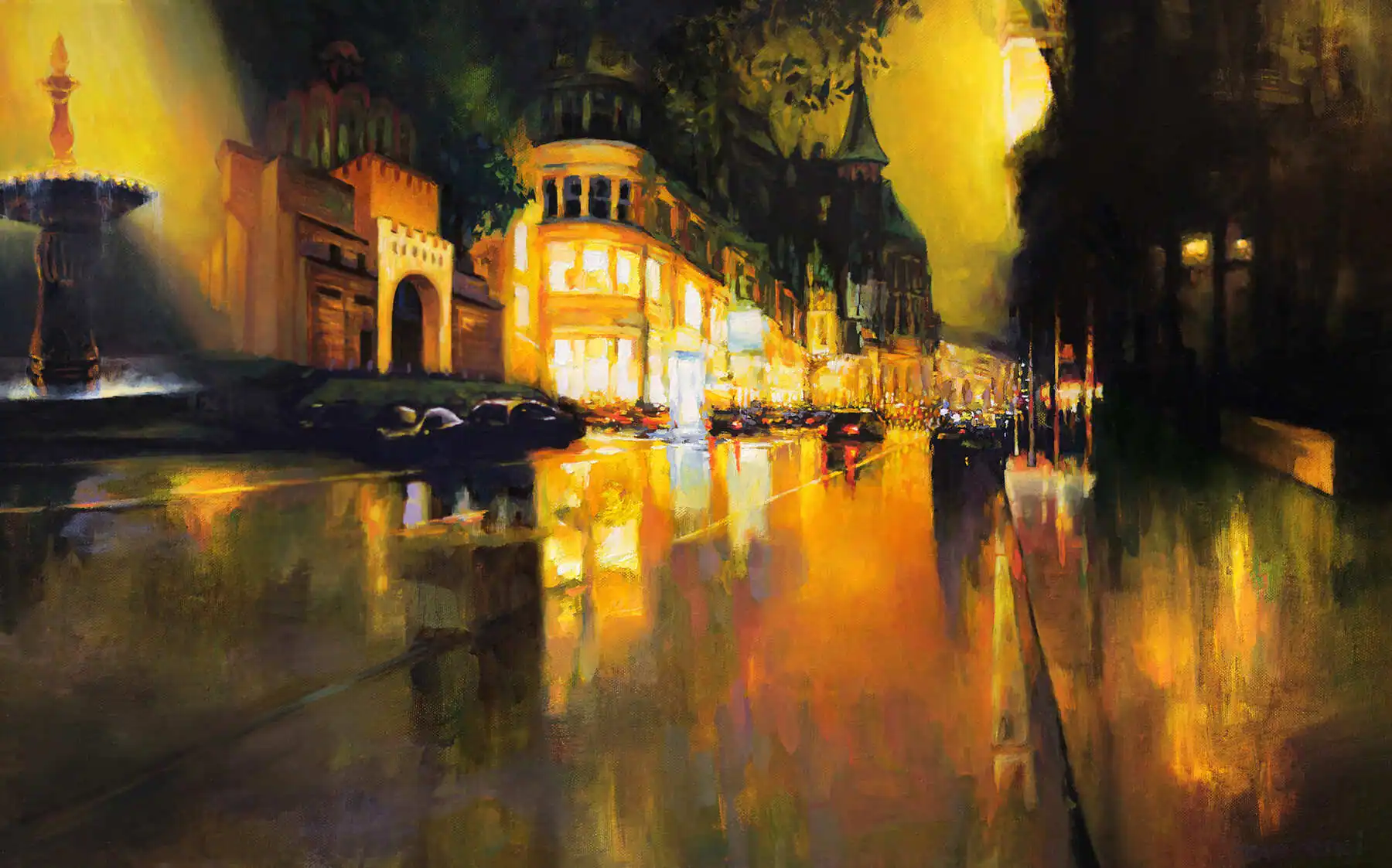
Beyond the old fortress walls, the town greeted me with dark streets, endless archways and empty courtyards between ancient buildings. The evening light made everything even stranger. Familiar reality was slowly turning into the set of an old film.
North of Zamość lay empty hills, old cobbled roads leading nowhere and solitary stone crosses in the middle of the forest. Night had fallen completely. All artificial light had disappeared — no streetlamps, no moon, no cars. Only the narrow beam of my bicycle light cut through the endless darkness.
I rode for a long time through that absolute emptiness. Then lights began to appear ahead. At first I took them for windows. But as I came closer, I saw what they really were: crosses and statues of the Virgin Mary, standing one after another along the road. In each of them a small lamp was burning — a tiny living heart in the impenetrable dark.
Racing through the dark villages, I kept peering at the houses, searching for any sign of movement. Only black shadows flickered past.
As I was leaving one of the villages, I suddenly saw a man running towards me from between the houses, shouting as if trying to say something or stop me. He flashed through the beam of my light and was gone, but the cry seemed to hang in the air long afterwards.
A bad omen.
The villages came to an end. It was time to find somewhere to spend the night. Just then, I was passing the hostel where I had originally planned to stop. The night was warm, I still had plenty of energy, and Lublin wasn't far away. I decided to keep going.
It was a fatal mistake.
The cold came suddenly, as though someone had blown out all the warmth in a single breath, like the flame of a candle. In an instant, the gentle summer air was gone. Real autumn had arrived. I had ridden straight into a northern cyclone.
The drizzle grew heavier by the minute, and the cold seeped into my bones. I began to feel strangely as though something were slowly draining the strength out of me. Riding became increasingly difficult. I was growing weaker by the minute.
The hostels were closed. There was nothing left to do but keep going.
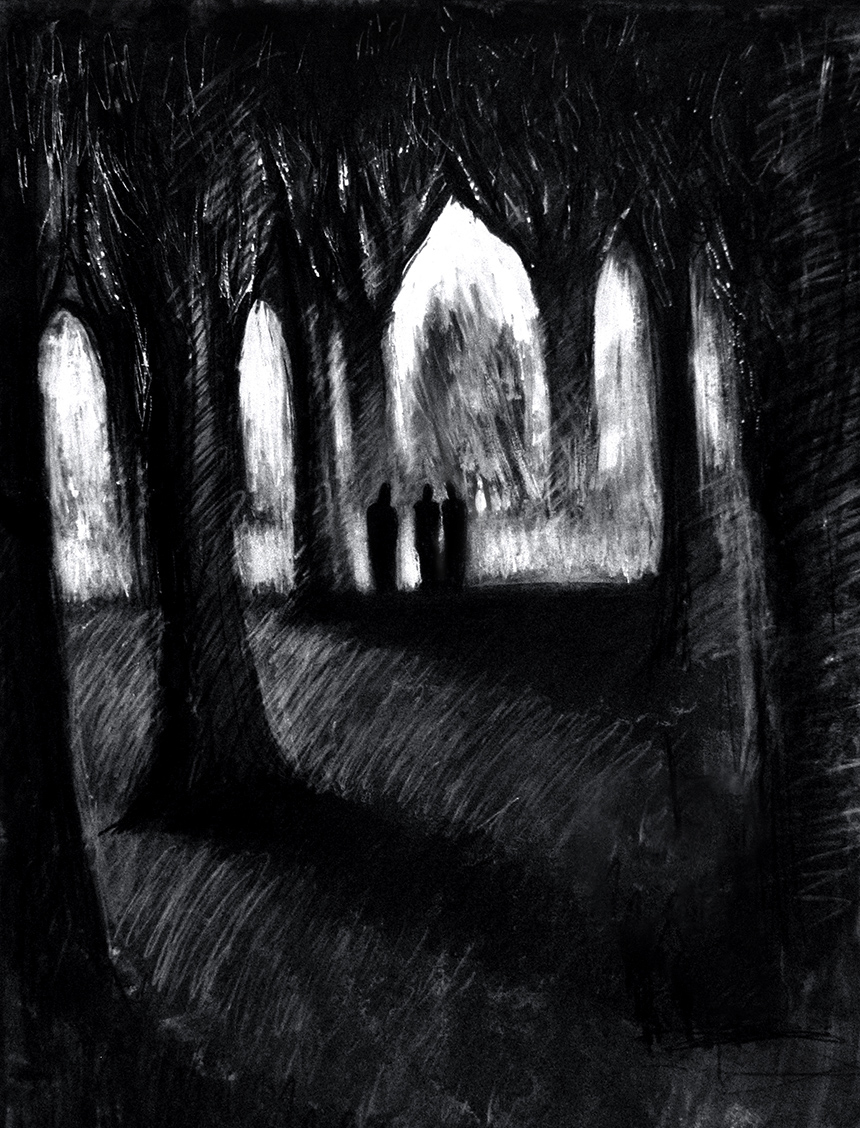
The air smelled of fallen leaves, wet bark and stagnant water in the hollows. Dark silhouettes of trees crowded right up to the edge of the road. Bare white branches stretched overhead, intertwining in a strange embrace and forming a canopy above me.
This was the edge of civilisation. Beyond it lay the unknown. The old world was disappearing, giving way to a dreadful darkness.
This place had existed long before humans — outside time itself, like some ancient, dark temple. Above me, a roof of wet branches and yellow leaves had closed in. The twigs merged into a solid, pitch-black canopy, with only occasional gaps revealing fragments of an icy sky.
The rain poured without pause, beating against my face. I was already soaked to the skin.
Somewhere in the thicket, I heard a strange sound. For a moment, the thought crossed my mind: perhaps Totoro was about to emerge from the darkness — a huge, gentle spirit of the forest. Something was moving deep among the trees. Something large. And it was unlikely to be Totoro.
The sound would fade into the distance, then suddenly seem to come from somewhere very close, before drawing menacingly near again. The wind roared and howled. Black shadows darted through the cold light, and the whole scene seemed almost unreal. The trees had lost their sharp outlines, their blurred silhouettes capable of resembling almost anything to an exhausted imagination. Most likely, it was just a deer.
At one point, a small animal darted right across my front wheel. Its green eyes flashed for an instant in the beam of my light — and then it was gone.
The forest seemed like one enormous living organism. Trees swayed in the gusts of wind. The air in the gloom smelled of pine, moss and cold.
The only warmth and light, apart from my own bicycle lamp, came from the trucks passing by. Powerful beams from their headlights pierced the curtain of rain, making the arches of trees flare into life for a brief moment.
At last, the forest came to an end. Ahead lay a steep descent, and far away on the horizon, through the rain and mist, the lights of a large city glimmered faintly.
I plunged downhill at tremendous speed, barely keeping my bicycle under control on the wet asphalt.
The first rays of sunlight were already breaking through the pale morning mist. In a couple of hours, I was supposed to reach Lublin.
By morning, I was a shadow of my former self. A sleepless night in the rain had drained every last bit of strength from me. Fine needles of pain pierced my muscles. A light mist hung in the air, and the drizzle continued. There was a similar fog in my head — everything seemed slightly unreal. I needed to get some sleep, even if only for a little while. But where?
By midday, I finally reached Lublin. I was already entering the city along a major road. Just a little further and I would be on a bus, heading back to Ukraine.
I found myself in the middle of a large interchange. I needed to get to the other side, where the traffic was moving more slowly. I let one car after another pass and gradually edged towards the roadside.
And at that very moment, I was suddenly thrown into the air, bicycle and all.
The world stopped. My body became completely weightless. I lost all control. My sense of self vanished for an instant — as though I had temporarily ceased to exist. No sounds. No sensations.
I was hurled against the windscreen, then thrown into the air again — and suddenly I was flying towards the asphalt, together with my bicycle. Everything became a blur: the road, the bicycle, the car.
For the first few seconds, I couldn't understand what had happened. I got up. Picked up my bicycle. I was about to carry on.
Then it hit me. Those could have been the final seconds of my life. Everything could simply have disappeared.
A car coming down from the bridge had struck me from behind. The impact was so violent that the rear of my bicycle had been reduced to a heap of twisted metal, while the entire front of the car was wrecked — the windscreen shattered, the bonnet crumpled.
I should have died from an impact like that.
But somehow, miraculously, I was still alive.
I had nothing more than a few minor scratches.
As if from underwater, I heard people shouting. A woman climbed out of the car and rushed towards me. She asked how I was feeling and offered to take me to hospital.
The police arrived almost immediately. As soon as they realised I wasn't Polish, they put me straight into a police car. Nobody even bothered to check whether I was bleeding or had broken any bones. They simply drove me to the station.
The nightmare didn't end with the accident. I was told I could now spend a couple of months in pre-trial detention while the Ukrainian authorities dealt with my case. Or I could pay a rather substantial fine. Nobody really explained what would happen next.
Then I heard something even more surreal:
"If you'd died on the spot, there wouldn't have been any problems at all."
Well, that woke me up. An accident. Somehow I had survived. Now I was under arrest. And I was facing either a fine or prison.
As it happened, I had no money to pay.
I didn't have anything like that amount with me. My Polish acquaintance had to pay it on my behalf.
And the strangest part was that only a small portion of the money went to the woman, even though I had thoroughly wrecked her car and the fine clearly didn't cover the damage. The police pocketed the rest — for a job wonderfully well done.
Once they had guarantees that the money would be paid, they let me go.
And issued their verdict: I had hit the car with my bicycle.
Half-dead, I limped towards my bus.
For the entire journey, one thought kept coming back to me.
I found myself thinking about my childhood, Kyiv, the people I had met, the cities I had visited. I have an endless number of thoughts, plans, memories and impressions. I experience the world from one particular point — the point of my own consciousness.
And one day, that point will no longer exist.
There will not even be anyone left to notice its absence.
Enjoyed 'Last Indian summer '? Drop your email — I'll send you a story from my next trip